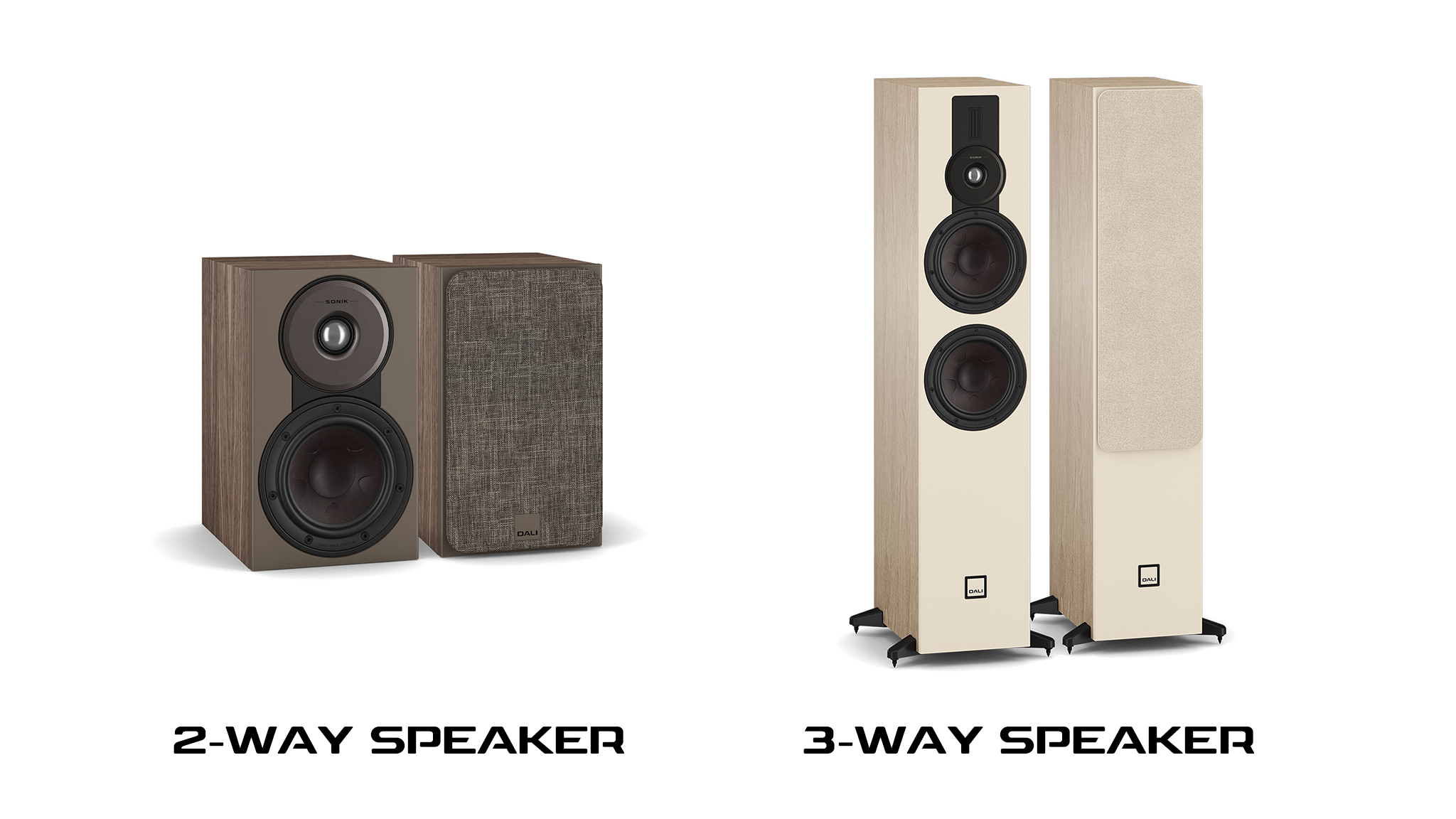
Very early in the history of speakers, it was discovered that adding extra drivers, each dedicated to part of the frequency range, produced a better sound than a single speaker unit. The 2-way speaker driver configuration became the de facto standard, with a small, fast tweeter handling the highest frequencies, with a larger woofer handling the midrange and bass. People later started asking the question: “Why not add extra drivers, each handling a narrower range of frequencies?” With the possibility of a midrange driver below the tweeter, leaving the woofer purely as a bass driver, the debate over 2-way vs 3-way speakers began.
So, do multiway speakers always offer a better sound, and what are the advantages of even more complex driver configurations? That’s what this guide will explore and explain…
 In very broad terms, this could lead to the woofer, for example, operating in the opposite direction to the tweeter in a 2-way speaker – so the woofer “sucks” while the tweeter “blows”. This can lead to the signals from the two cancelling each other out, confusing the coherence of the sound, and thus the imaging of a pair of speakers. So, care must be taken in crossover design to compensate for these phase shifts. And of course what can be a problem in a simple 2-way crossover becomes even more complex as more stages are added to the crossover in multi-way speaker designs.