2-way vs. 3-way speakers – A guide to multiway speaker design

Very early in the history of speakers, it was discovered that adding extra drivers, each dedicated to part of the frequency range, produced a better sound than a single speaker unit. The 2-way speaker driver configuration became the de facto standard, with a small, fast tweeter handling the highest frequencies, with a larger woofer handling the midrange and bass. People later started asking the question: “Why not add extra drivers, each handling a narrower range of frequencies?” With the possibility of a midrange driver below the tweeter, leaving the woofer purely as a bass driver, the debate over 2-way vs 3-way speakers began.

So, do multiway speakers always offer a better sound, and what are the advantages of even more complex driver configurations? That’s what this guide will explore and explain…

by Thomas S.

April 10th 2026

What is a 2-way speaker?

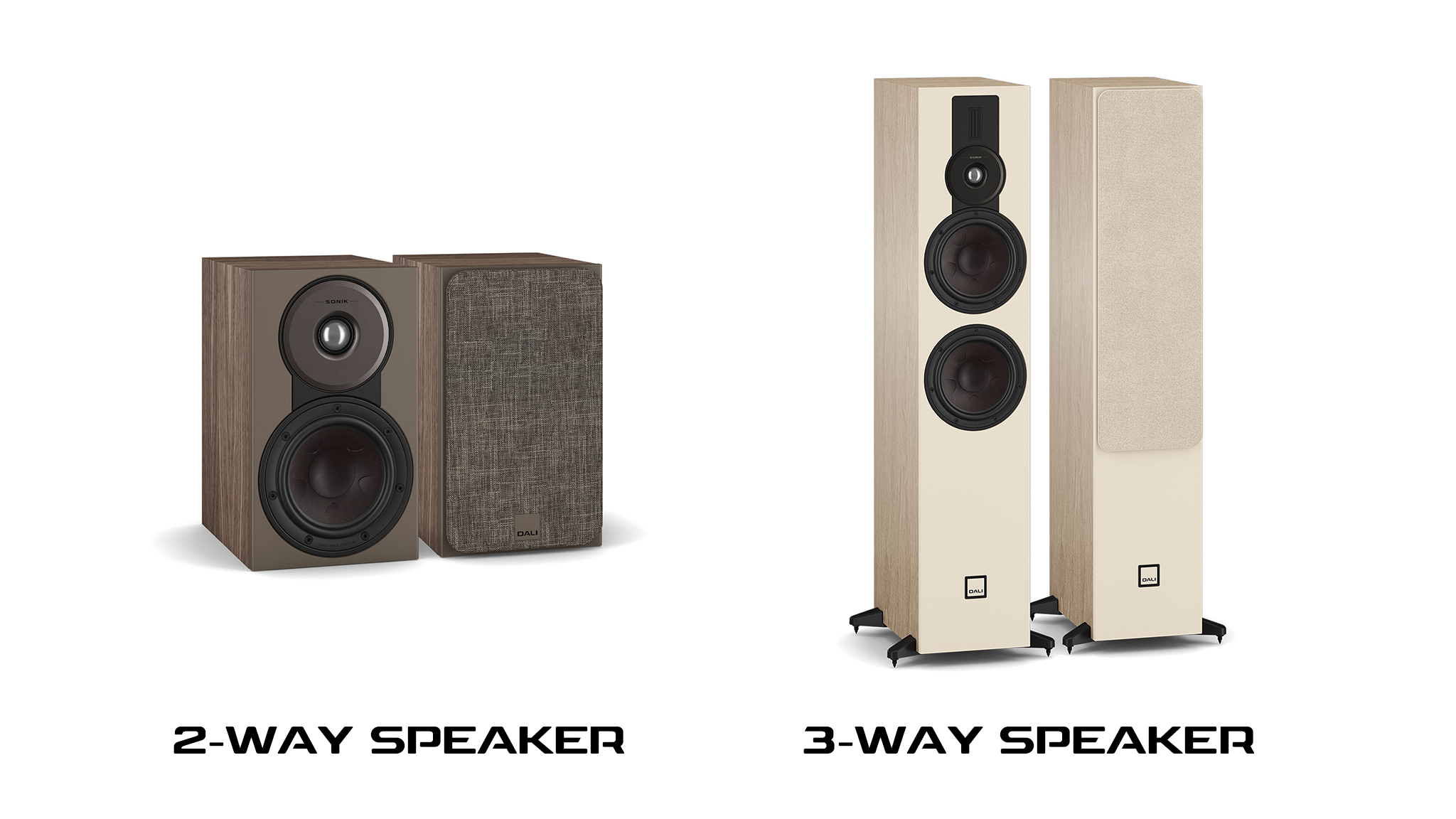
Especially at the entry level of speakers, 2-way speaker design is the standard, with a woofer and tweeter covering the entire frequency range. The tweeter reproduces the highest frequencies, while the woofer handles the midrange and bass – or mid/bass. The tweeter is usually mounted above the woofer, as it tends to produce more directional sound waves and therefore needs to be at or around the listener’s ear height. However, it’s useful to have the two drivers close together, to aid integration between them – oh, and it allows for smaller speakers. 

The crossover point between the two drivers will vary according to the characteristics of the drivers used. But, in simple two-way designs it’s commonly around 2–3kHz, which creates a smooth handover between the tweeter and woofer. 

On the plus side, two-way designs are relatively simple and inexpensive. Getting the two drivers to work together in phase is also relatively straightforward, resulting in excellent integration. The downside is that such a design places a lot of pressure on the midband capabilities of both drivers, often pushing them near their natural frequency range limits.  

What is a 3-way speaker?

The solution to the compromises of a 2-way design is to add a driver between the high- and low-frequency units, creating a 3way speaker design with a woofer + midrange + tweeter configuration. One drawback of 3-way designs is the added cost and the need for larger front baffles. This is because the midrange driver is conventionally placed between the tweeter and woofer, which forces the speaker to be larger overall.

However, for many designers, the benefits of a 3-way design outweigh the drawbacks, as it avoids having to force the tweeter and woofer to operate at their extremes to “meet up in the middle”. Adding a midrange driver enables the speaker to offer better definition and clarity in the vital frequency region covering voices and instruments. The midrange driver will commonly carry frequencies from 200–500Hz to 2–4 kHz, also allowing both the tweeter and woofer to perform within a smaller range. But, care must be taken to engineer the crossover in these more complex speakers for correct integration and phase characteristics.

Beyond 3-way: Advanced multi-way configurations

We’ve established that adding a dedicated midrange driver can bring the benefits of smoother response from and integration between the drive units. However, some speakers take things even further: these multi-way speaker systems add extra drivers dedicated to specific frequency bands. That means drivers can be more closely tailored to their task and can also extend the frequency range of the entire design, for example with supertweeters operating above the usual high-frequency driver range, or bass drivers dedicated to very low frequencies. 

Add one of these elements, and you create a 4-way system, or add both high and low frequency extension drivers and you theoretically create a 5-way design. However, it’s more common to overlap the roles of the drivers in the design of the crossover, dividing the input signal between the drivers to create what’s called a 4½-way system. 

The benefits of these advanced multi-way designs are clear to hear in terms of greater clarity, but they tend to be used in high-end designs for reasons of complexity (not least in the crossover design) and cost. It also increases the physical size of the enclosure required to house all those drivers. It’s also arguable that it’s only in high-end, ultra-high-resolution systems that the benefits of such designs will be apparent. 

Did you know..

A speaker with one tweeter and two woofers isn’t automatically a 3‑way system. For it to truly qualify, the internal crossover must split the audio into three distinct frequency bands one for each driver type. If the crossover only divides sound into two ranges (highs for the tweeter, lows for both woofers), then it’s technically just a 2‑way design, even if there are three physical drivers.

What Does “½Way” Mean in Speaker Design?

The theoretical ideal might be a multi-way speaker with a crossover output dedicated to each driver – so three drivers means a three-way speaker, four drivers a four-way and so on – but you’re likely to discover speakers described as 2½-, 3½- or even 4½-way. So, what’s going on? 

Well, in one of these “-½-way’”designs, the speaker still has a crossover of, say, a three-way design, but could have a tweeter, a midrange driver and two woofers. The bass units are both fed from the same “leg’” or output of the crossover, but one of the two bass drivers is tuned to reproduce only the lower part of the frequency range of the other. This is usually done with an extra inductor in series with one of the woofers, causing it to roll off at a lower frequency than the other, with the effect of boosting the lower bass output (but not the lowest frequency the speaker can deliver). 

A common role of this ½‑way design is to boost bass output using a process known as baffle step compensation. This addresses the effect where low frequencies, because of their longer wavelengths, wrap around the edges of the speaker cabinet and are lost compared to the forward projection of higher frequencies. 

Did you know..

A passive crossover wastes some energy as heat, while an active crossover splits frequencies before amplification, giving more control and efficiency.

Key Differences and Tradeoffs

So, now we’ve examined the differences between 2-way vs 3-way speaker design, are the theoretical advantages of a 3-way design always borne out in the listening experience? 

Well, the benefits of a discrete 3-way design over a 2-way speaker should be obvious: each of the three drivers is working within the frequency range in which it delivers the purest sound. You should experience improved clarity, stereo imaging and both bass and treble extension. In particular, the presence of a dedicated midrange driver will mean the bass unit doesn’t have to reach up to cover more of the vocal/instrumental band and can be tuned lower to deliver better scale and substance. And with a 3½-way design, the woofers can be doubled up, with one tuned for really deep bass. 

Adding more drivers also improves both power handling and sensitivity. As a result, the system requires less amplifier wattage to reach the same output level, reducing strain on both the amp and the speakers. Logically speaking, this should also help them last longer. 

However, it does tend to mean larger cabinets will be required, not just to house the extra driver(s) in the front baffle, but also to allow separate spaces within the enclosure in which each driver can work. Crossovers will also be more complex, and expensive, so while there are some relatively compact 3-way speakers, this configuration is generally more widely used in larger floorstanding designs. 

Related article

Active vs. passive speakers

Discover the differences between active and passive speakers and which is best for your needs.

View Article

What Matters More: Price or Driver Count?

Although a 3-way speaker does have theoretical and practical benefits, the modern 2-way speaker is a highly developed concept. A well designed 2-way can use better drivers, crossovers, and cabinet construction than a 3-way at the same price, which can result in cleaner, more accurate sound. 

Also, budget-restrained 3-way speakers may suffer from poor crossover integration and low-grade components in the drivers and crossover, leading to a muddier midband and less coherent imaging. 

However, when comparing equally high-quality designs, a 3-way’s dedicated midrange driver usually delivers more accurate frequency separation and better dynamics

The bottom line is that you shouldn’t buy on driver count alone – a 2-way design using higher quality components may be better suited to your needs than a 3-way at the same price. So, it’s important to audition and compare within your budget tier. 

Sound Quality Considerations

The main benefit of speakers with more drivers isn’t simply that more drivers mean more sound, or even louder sound: instead, increasing the number of drivers means each can be better optimised for its intended task. Every drive unit has a finite range of frequencies it can cover, and pushing it near to these limits can impinge on overall performance: keeping the driver well within its “comfort zone” will deliver greater speaker clarity, which in turn will deliver more precise imaging and stereo soundstaging – in other words, more of the music. 

In particular, a dedicated midrange driver will enhance the speaker’s accuracy in vocals and instruments, with greater clarity from giving these frequencies a driver designed to reproduce them, rather than placing them in the crossover zone between the tweeter and the mid/bass driver of a 2-way design. 

By also taking over some of the upper mid/bass frequencies, such a design will also enable the woofer to be “tuned down” to improve bass extension, which can be further improved by adding an extra woofer in a 3½-way design. 

Phase Alignment and Why It Matters

Whatever the configuration of a speaker, it’s important to maintain phase alignment between the drivers, ensuring all of them – tweeters, midranges and either mid/bass drivers or woofer – are all moving in synchronisation. One of the problems of the filtering used in a crossover that divides the input signal between the drivers can be that it inverts, or at least skews, the signal going to the various drivers. In very broad terms, this could lead to the woofer, for example, operating in the opposite direction to the tweeter in a 2-way speaker – so the woofer “sucks” while the tweeter “blows”. This can lead to the signals from the two cancelling each other out, confusing the coherence of the sound, and thus the imaging of a pair of speakers. So, care must be taken in crossover design to compensate for these phase shifts. And of course what can be a problem in a simple 2-way crossover becomes even more complex as more stages are added to the crossover in multi-way speaker designs.

How to Choose the Right Configuration

There are multiple factors involved in choosing speakers for your needs, and any speaker buying guide should include considerations beyond simply your budget and room size. 

Tempting though it may seem to buy the biggest speakers your budget will allow or the most impressive-looking multi-driver design purely for visual impact, it may make better sense for you to invest the same money in a smaller, higher-quality speaker that may well give better results, especially if you have a relatively small room.

True, if you favor bass-driven rock music or EDM, or even large-scale orchestral or operatic works, the extra bass extension afforded by 3-way designs or even more complex configurations might be attractive. However, you should also consider whether the larger speakers might over-drive your room, resulting in exaggerated, uncontrollable bass. You might do better to consider a simpler, high-quality 2-way design, then dial in some extra bass extension using an active subwoofer, which will allow you to tailor the low frequencies to suit your room and tastes. 

Finally, ask yourself whether your existing amplification is good enough to bring out all the qualities of a complex, multi-way speaker: you may need to consider an upgrade in the amp department if your heart’s set on those big 4½-way floorstanders. 

Conclusion

By now, you should have a better understanding of the principles of multiway speaker design and be able to choose between these more complex designs and simpler, more compact 2-way speakers. 

Yes, speakers with a dedicated midrange driver will tend to offer better insight into vocal and instrumental character and textures, but don’t skimp on quality: logic suggests a 2-way design will use higher-quality components than a 3-way model at the same price. And more complex speakers, with additional bass drivers for example, may simply be too big for your room, even if your amplification is up to the task of exploiting their advantages.  

The answer, above all, is that you should listen, listen and then listen some more. Try the speakers you’re considering with the music you like, with the kind of system you use, and preferably in a room like yours. It’s worth all the effort and you may be surprised what your ears, not just your eyes, suggest is best for you. 


Explore high-quality DALI multi-way speakers

DALI offers a range of acclaimed floorstanding speakers, compact speakers and custom install speakers, with a range of multi-way designs for any room and any budget. To learn more, locate your nearest DALI dealer here and experience authentic DALI sound for yourself. 


Optional FAQ Section

  • Is 2-way or 3-way better for bass? 
    A 3-way speaker usually delivers better bass than a 2-way design because it has a dedicated woofer for low frequencies. In a 2-way, the woofer also handles midrange, which limits deep bass. 

  • Are 4-way speakers worth it?
    In a suitably revealing system, yes, 4-way speakers are worth every penny. They allow each section of the speaker to fulfil its full potential, delivering a wider, more focused full-frequency sound. 

  • What does 4½way mean?
    A 4½way speaker is essentially a 4-way system with an extra bass driver that overlaps part of the range. The crossover sends the deepest frequencies only to that additional woofer, while the other drivers handle treble, midrange, upper bass, and lower bass. The “½” indicates that the extra driver doesn’t cover a full, separate band – it just reinforces the lowest end to smooth response and prevent bass loss from the baffle step effect.

  • Can a 2-way sound as good as a 3-way? 

    Yes, a 2-way speaker can sound as good as a 3-way speaker, especially at the same price. A well-built 2-way often uses higher quality drivers and crossover parts, while a budget 3way may compromise on component quality. 

  • Do I need a subwoofer with 3-way or 4-way speakers? 

    You don’t necessarily need a subwoofer for 3-way or 4-way speakers, as they already extend bass. However, adding one can give tighter, more controlled low end and lets your main speakers work less hard. In simple terms, you’ll hear bass that feels deeper, cleaner and more effortless – also at lower volumes. 

Compare Products

Subscribe to our newsletter and stay up to date with all news and events.